Recognizing objects across different views
Froudarakis and colleagues trained mice to distinguish objects shown in movies that varied their position, scale, pose, and illumination. The mice learned to identify the objects and generalized to views they had never seen before. In separate recordings, the team used two-photon calcium imaging to measure responses across the visual cortex while mice viewed the movies.
Modeling the geometry of object representations
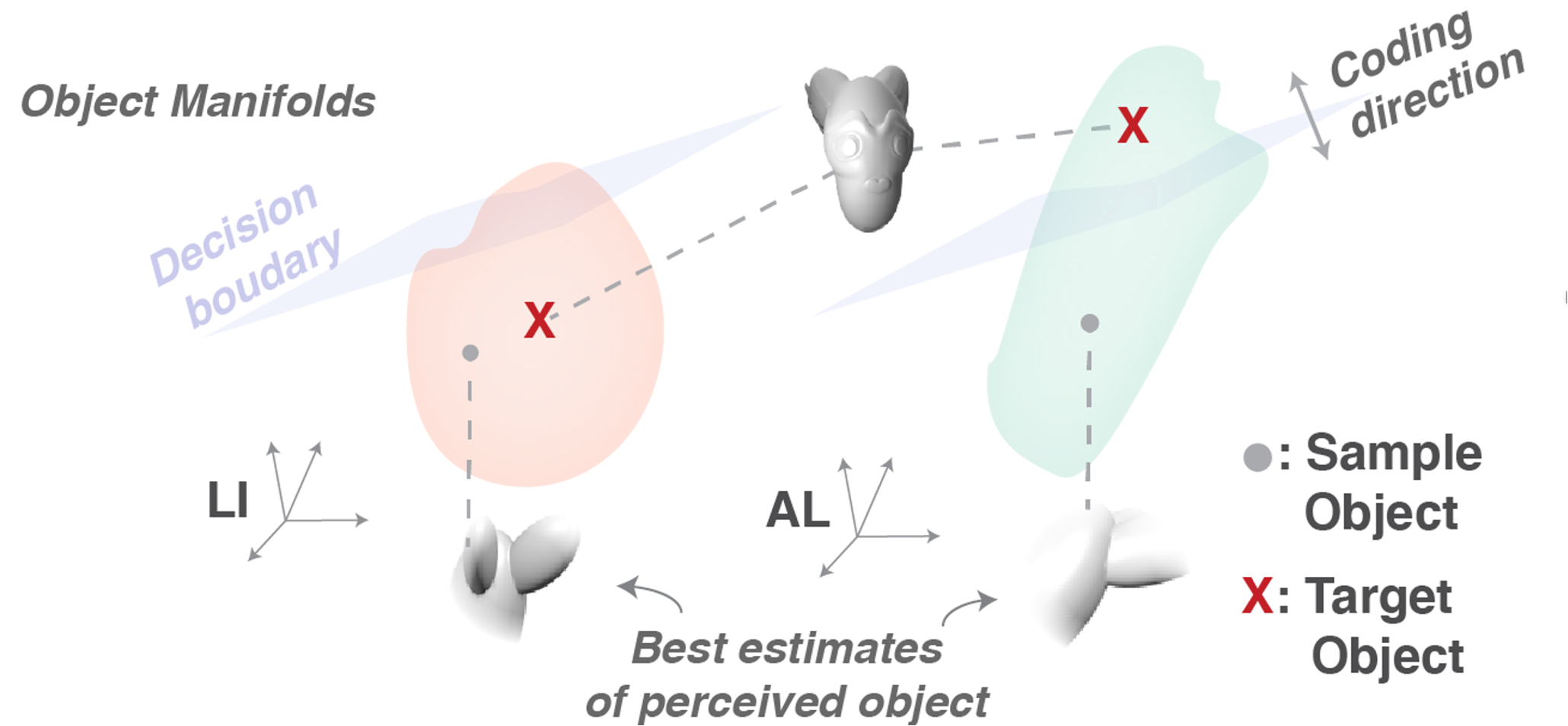
Each view of an object evokes a pattern of activity across many neurons. In the model, each pattern is a point, and the points from different views of the same object form an object manifold. The study asked whether a weighted sum of neural activity could distinguish one object from another across these changes in appearance.
Object identity was easier to decode with a linear readout in the lateral visual areas LM, LI, and AL than in other visual areas. The manifold analysis linked better separation to representations that occupied less space and varied along fewer dimensions. This offers a geometric explanation for how object identity can become easier to read out even as the image changes.
Read the study
Froudarakis et al. (2026). Object manifold geometry across the mouse cortical visual hierarchy. eLife reviewed preprint.